
Formal “Pitch” to Professor Sweeting
The College of General Studies Humanities 104 course covers several art movements, works of literature, musical pieces, and key themes. In the course, students grapple with ideas such as the role of nature in our industrialized world, the hierarchical order of social classes, nostalgia developed throughout childhood, and the way in which our individual personal being can also be political. The Impressionist art movement that began in Paris, France in the late 1800s emphasized course themes by calling attention to the growing impacts of industrialization on both rural and urban areas, while often depicting nontraditional subjects of ordinary people and scenes of everyday Parisian life. Founding Impressionist artists like Claude Monet (1840-1926) and Pierre-Auguste Renoir (1841-1919) directly protested the accepted artistic practices of Paris at the time that revolved around the French Academy and its government sponsored exhibitions called Salons. The art in these exhibits often only portrayed significant historical events and the upper class, but in complete contrast, the Impressionists aimed to depict relatable, short-lasting moments of the lives of both countryside and city individuals in the middle class. The most common settings tended to be those that involved leisure time: activities in the countryside on the outskirts of Paris or any of the numerous cafes and restaurants that had grown to be a huge part of Parisian culture. Pierre-Auguste Renoir’s painting The Skiff (La Yole) expresses the Impressionists’ fascination with how the countryside interacts with urbanization and can be connected to poet William Wordsworth’s contemplation of experiencing in the moment versus later in reflection. Edouard Manet’s painting At the Cafe, in contrast, depicts the Impressionist interest in city cafe scenes through multiple representations of different social classes, and reflects the consumer paradise and adventurous nature of Paris in Guy de Maupassant’s short stories. Both paintings, when combined with course reading materials, create a complex picture of Paris in the late 1800s that relate to course questions about the role of the natural world in an industrialized society and the changes in representation of traditionally underrepresented groups in a progressing society.
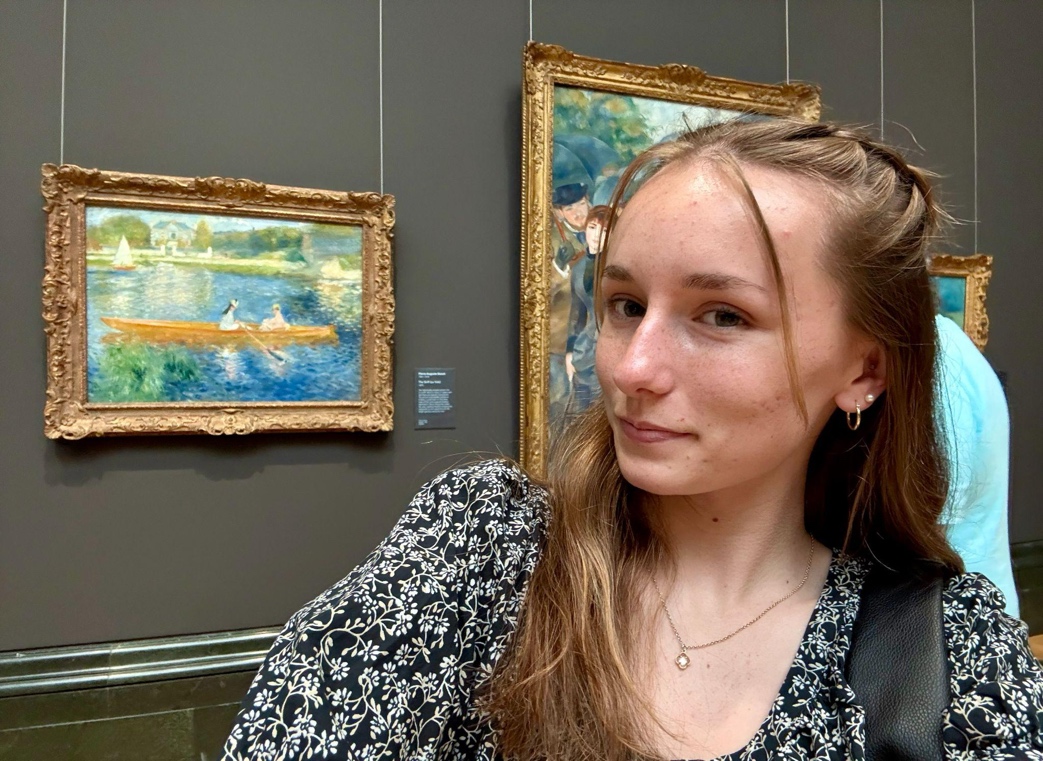
 Renoir’s The Skiff (La Yole) from 1879-80 embodies both Impressionist stylistic art form and easy access to the countryside due to new rail lines and transportation. The painting itself (see image to the right) is oil on canvas, and has been on display at London, England’s National Gallery since it was acquired in 1982. The setting is most likely of the River Seine near the town of Chatou, but the specific location has never been confirmed.1 From a general perspective, the painting shows two fashionably dressed women, rowing in a small skiff along the river, and a railway bridge that is almost out of view along the skyline above the treetops. The common activity is painted in the Impressionists’ signature style of bright colors and light subject matter with few, less intense shadows. The brushstrokes in the foreground are bold and noticeable, but they become smoother and create a blur effect as they continue into the background. Renoir’s specific touches are the way in which the light reflects and “shimmers” across the water, and the conscious choice to make the skiff a bright orange, contrasting the light and deep blues of the surrounding river. He played off new advancements in the understanding of complimentary colors.2
The Skiff (La Yole) follows the Impressionist trend to depict the movement of city-goers to the countryside due to the increasing accessibility of transportation. These areas provided busy Parisians a stark contrast to the quick-paced and overpopulated city. Instead, they could engage in relaxing activities surrounded by the peace and serenity of the natural world. William Wordsworth (1770-1850), an English Romantic poet, explored the role of nature and its virtue in comparison to the slums of London in his time. To Wordsworth, nature had a certain healing or growing quality that allowed one to slow down and contemplate. The city, on the other hand, was often too fast-paced to live in the moment and take in one’s surroundings.3 Wordsworth extremely valued the act of experiencing: in his poem, “Composed upon Westminster Bridge, September 3, 1802,” he asserted a sense of specificity in the moment by making the date a part of his title and he created a scene that evokes all five senses when read. In this way, Wordsworth wrote as he was experiencing a London sunrise, on the bridge itself, instead of later on, from a removed setting.4 Similarly to this, Impressionist artists often created nature paintings outside, in the environment in which they occurred, rather than the traditional practice of using studio rooms.5 For Wordsworth and the Impressionists, the short moments–immersed in the natural world and removed from urban cities like London or Paris–had a new level of intimacy and personalization to relay the individual experience.
Although Wordsworth and the Impressionists lived almost 200 years ago, the fleeting role of the natural world is not a struggle that is lost to us today. They may have been perplexed by trying to balance steam engine trains, electricity, and eventually the combustion engine that would be used in automobiles, but today we have become even more distanced from the rural and natural parts of the world around us. The internet and its associated forms of entertainment such as movies, video games, and social media only push us further away from the outdoors and traditional activities that took place in those environments. Impressionist paintings like Renoir’s The Skiff (La Yole) force us to recognize that missing connection with the natural world that is often overlooked in the convenience of the forms of entertainment present today that can be acquired by simply pressing a few buttons on any kind of portable, mobile device.
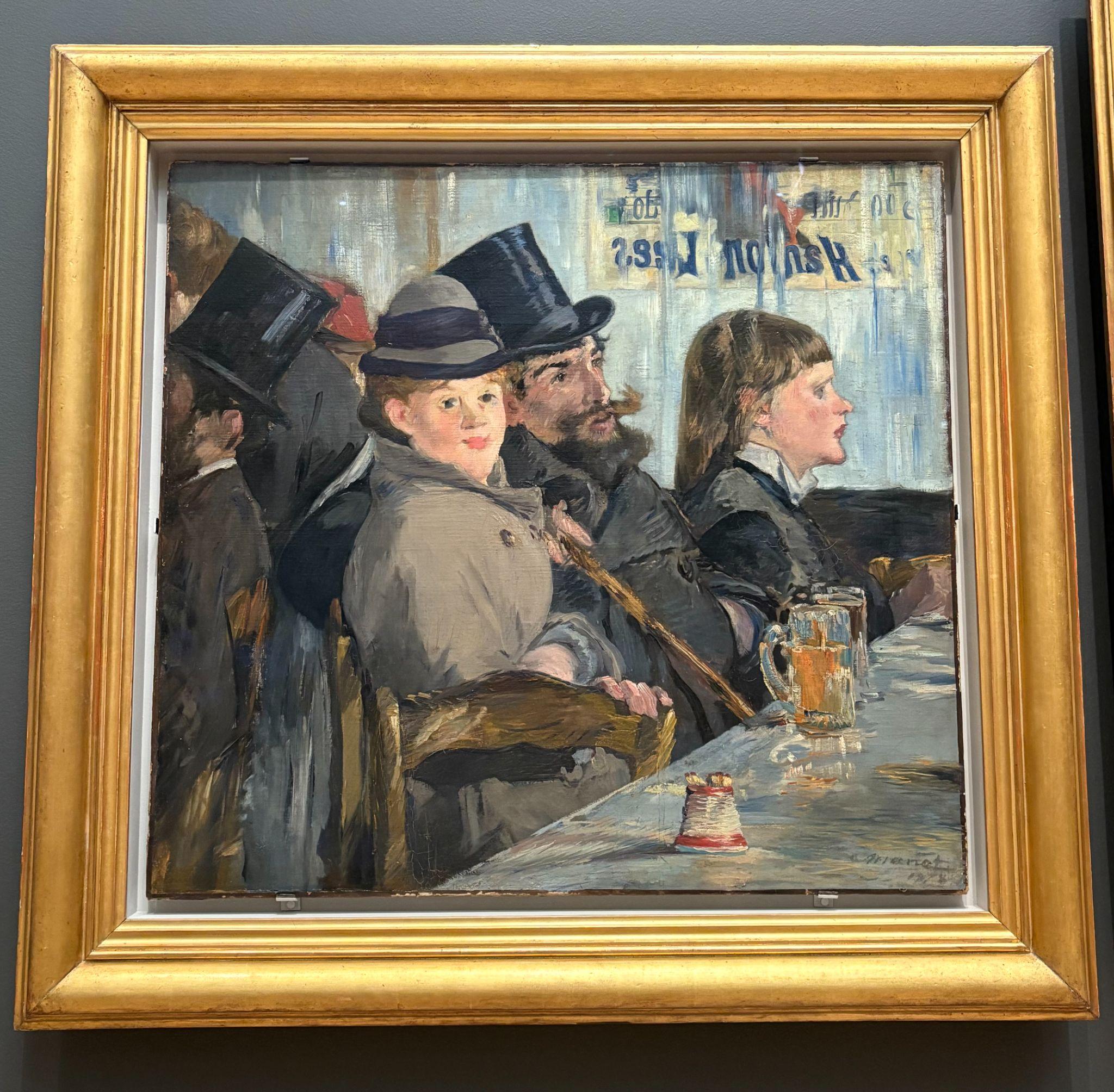 Manet’s At the Café from 1878 embodies the other side of preferred Impressionist setting and subject matter: cafe and pub-style community gatherings in Paris. This oil painting on canvas hangs at the National Gallery among the previous The Skiff (La Yole) and other influential impressionist pieces (see image to the right). The painting was originally a part of a larger piece that was composed of both At the Café and another segment named Corner at a Café Concert, but Manet chose to split both segments into their own paintings in 1878. The selected half, At the Café, shows Parisians enjoying a concert (not pictured, but more apparent in the other half) with a few pints of beer at one of the many local brasseries. These spaces provided friends with drinks and entertainment that made meaningful quality time out of leisure time away from work. The man in the center of the painting has been identified as lithographer Henri Guérard and the woman he is leaning on to his right is actress Ellen Andrée, who happened to be a common model for many of the Impressionists.6 Manet uses similar brushstroke techniques as Renoir, which clearly shows the deliberate direction of the strokes without much blending. Manet used a much darker color palette than Renoir at points, particularly through using more shadows and depth to illustrate the ambiance of the brasserie. The golden orange of the beer in the pints contrasts the light blue paint on the walls; Manet was influenced by the same laws of complementary colors as Renoir.
The painting, from a glance, probably seems to only convey the conversations of friends and the enjoyment of the lively environment of Parisian brasseries. Despite this general first impression, Manet works in a deeper symbolism beyond what one first notices: the top hat on Guérard represents the dress of the upper class, whereas the bowler hat and simple dress on Andrée is typical of the bourgeoisie. If one looks closely, the working class also makes an appearance through the waiter in the background of the painting who is wearing a traditional blue apron or smock.7 This challenged the portraits and scenes from the Salon exhibitions mentioned earlier that likely would never have acknowledged the working or middle classes. Manet’s inclusion of many social classes formed a sense of unity and progress present in Parisian society that helped contribute to the collective community aspect.
Guy de Maupassant (1850-1893), a French author who is considered to be the master of short stories, wrote a series of short stories related to 19th century Parisian life. His stories like “A Parisian Affair” express parallel themes to Manet’s At the Café but go into more depth about the adventurous and daring environment that Paris fosters with its night and consumer scene. Maupassant focuses particularly on the way in which women, who were traditionally limited to extremely restricted roles in society, could go to Paris and let go of some of those social norms.8 Like Manet, Maupassant created space for individuals who were not traditionally represented. But whereas the painter did so by clearly depicting members of different social classes, Maupassant told the stories of women which had previously been unwritten. The economic and urban growth did not only affect consumerism and cafe culture but also fostered an environment of social change. Both the expanded mingling between socioeconomic classes and a greater presence of women in everyday life outside of the home were forces at the forefront of the altered status quo. The modern liberal society of the West has made abundant progress towards positive social change and securing rights for marginalized groups, but it is still important to understand where we have come from and which of those challenges we still face today.
Personal Conclusion
In my opinion, humanities courses are not meant to be stagnant. History plays an important part in providing context for what we learn, as I suggested in relation to social change, but it is not meant to feel stuck in time. The history that we capitalize upon in class should evoke modern-day questions that relate to the world around us. For example, with Guy de Maupassant’s short stories, I view them as relating to 21st century America despite being created in 19th century France. The theme of the representation of women and which rights they do or do not have is still of the utmost relevance today. Our course already has so many meaningful pieces of art, music, and literature that push the idea of history playing a huge role in the world today. Despite this, I found that the historical context and physical content of both The Skiff (La Yole) and At the Café made me think of certain questions and avenues that I hadn’t thought of before. These are not pieces of art that can be taken at face value without any analysis, as is especially true for the class element related to Manet’s painting. I believe in the process of deep thinking that comes with historically and socially nuanced pieces such as the two that I chose. In a world where technology and tools such as artificial intelligence are changing–arguably for the worse–the process and concept of education, these nuanced moments are the ones that will force students to think individually in a world full of growing conformity.
De Maupassant, Guy. A Parisian Affair and Other Stories. London: Penguin Classics, 2004.
Tate Britain & Modern. “Art Term: Impressionism.” Accessed June 21, 2025. https://www.tate.org.uk/art/art-terms/i/impressionism.
The National Gallery. “About the Work: At the Café.” Accessed June 21, 2025. https://www.nationalgallery.org.uk/paintings/edouard-manet-at-the-cafe.
The National Gallery. “About the Work: The Skiff (La Yole).” Accessed June 21, 2025. https://www.nationalgallery.org.uk/paintings/pierre-auguste-renoir-the-skiff-la-yole.
William Wordsworth. “Composed upon Westminster Abbey Bridge, September 3, 1802.” In Norton Anthology of Western Literature. New York: W.W. Norton & Company, 2014.
“William Wordsworth.” In Norton Anthology of Western Literature. New York: W.W. Norton & Company, 2014.
1. “About the Work: The Skiff (La Yole),” The National Gallery, accessed June 21, 2025, https://www.nationalgallery.org.uk/paintings/pierre-auguste-renoir-the-skiff-la-yole.
2. “About the Work: The Skiff (La Yole),” The National Gallery.
3. “William Wordsworth,” in Norton Anthology of Western Literature (New York: W.W. Norton & Company, 2014), 541-544.
4. William Wordsworth, “Composed upon Westminster Abbey Bridge, September 3, 1802,” in Norton Anthology of Western Literature (New York: W.W. Norton & Company, 2014), 554.
5. “Art Term: Impressionism,” Tate Britain & Modern, accessed June 21, 2025, https://www.tate.org.uk/art/art-terms/i/impressionism.
6. “About the Work: At the Café,” The National Gallery, accessed June 21, 2025, https://www.nationalgallery.org.uk/paintings/edouard-manet-at-the-cafe.
7. The National Gallery, Art Piece Description (Plaque.)
8. Guy de Maupassant, A Parisian Affair and Other Stories (London: Penguin Classics, 2004).