
Newspapers. Blogs. Books. Magazines. Radio. Television. Mass media permeates every aspect of existence, from the ads we quickly glance at while walking down the street to the cat videos we watch on Instagram. Mass media is defined as “forms of communication designed to reach many people,” and it is an undeniable and unavoidable part of modern life (“Mass Media”). How does mass media impact people? How is it a force for both good and bad? I will analyze the novella A Christmas Carol by Charles Dickens, the artwork Marilyn Diptych by Andy Warhol, and the sculpture Babel by Cildo Meireless to explore the nuances of mass media and argue that it functions as both an aid and a hindrance to humans due to its permanent presence in our lives.
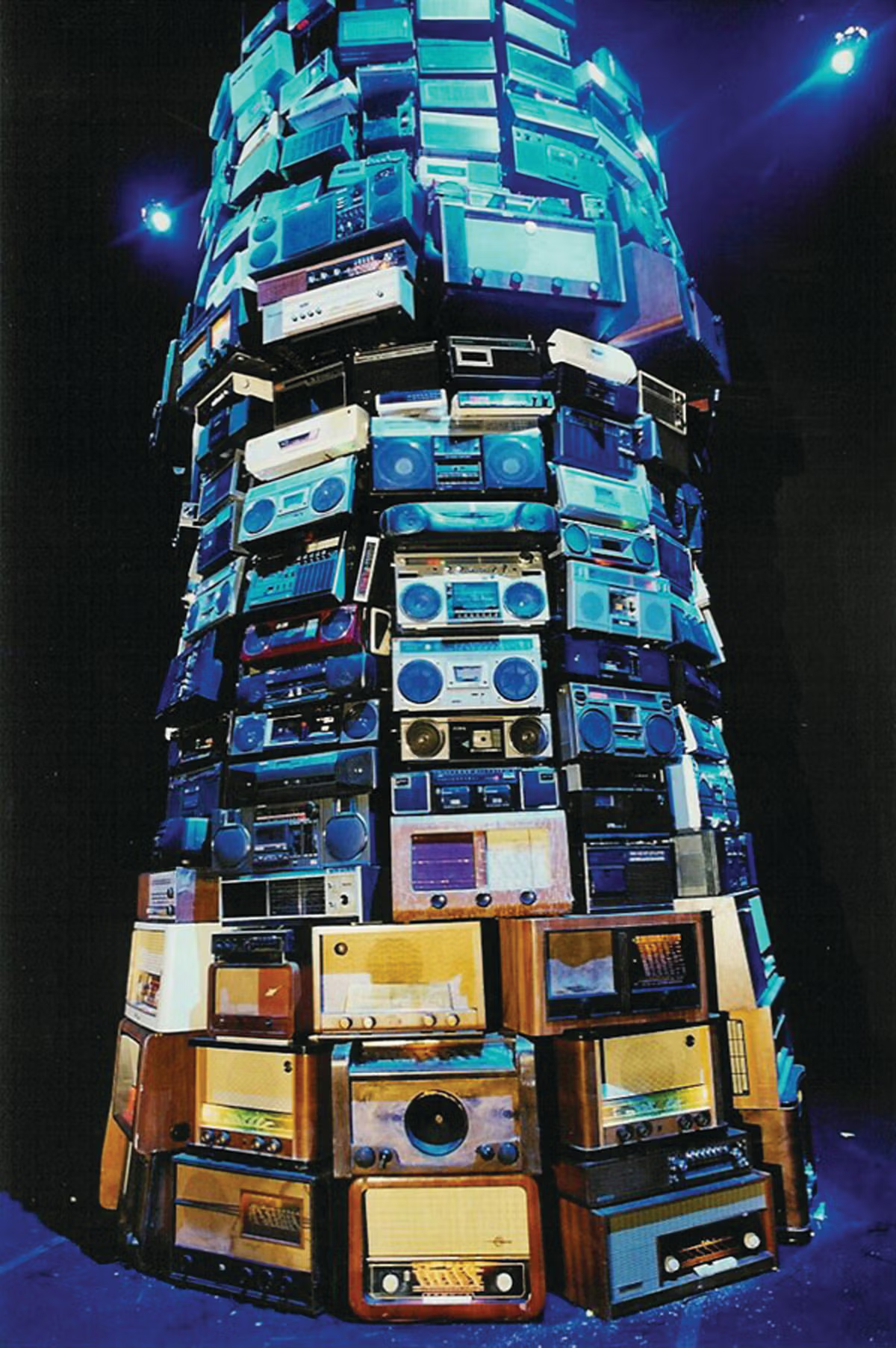
Upon first walking into the room in the Tate Modern where Cildo Meireless’ Babel is displayed (pictured above), I was surrounded by dim lighting and empty space. As my eyes adjusted, my view became swallowed by the towering structure in front of me. Made in 2001, the behemoth of Babel consists of hundreds of radios stacked on top of one another, each tuned to a different station (“Cildo Meireless”). The lines are straight and geometrical on the bottom and rounded on the middle and top of the piece. The frenzy of noise the sculpture plays is overwhelming and slightly painful to the ears, as dozens of voices, songs, and news broadcasts play simultaneously. In terms of materials, the radios’ ages correspond to the sculpture’s height chronologically, as large radios from the 1920s form the base and small modern radios model the top, narrowing the piece and emphasizing its lofty form (“Cildo Meireless”).
Babel is an ode to the confusion and anomie experienced by consumers of mass media. The word “Babel” refers to both the “babbling” of voices and songs coming from the radios and the Tower of Babel, a biblical story in which God is displeased with a tower humans build to reach the heavens (“Tower of Babel”). God confuses the builders of the tower by making them speak different languages, thereby halting the structure’s completion (“Tower of Babel”). This echoes how mass media constantly pushes new and conflicting information onto consumers, akin to a mental tug of war. The height of the sculpture symbolizes the colossal presence of mass media in human life, and the darkness of the room expresses how mass media, such as social media, television, and books, can act as a welcome escape from the bleakness that everyday existence can be. Similar to the fever dream of voices weaving in and out of my ears when witnessing Babel, it is hard to tell truth from lie and useful from useless when being inundated with so much knowledge. Alongside confusion, this can cause feelings of isolation due to comparison with others’ carefully curated virtual lives. I am reminded of my struggles with synthesizing all the different, unending information provided by social media, from what is healthy to eat and whether a friendship is worth keeping. I am also drawn to reflect on how London has helped me step back from the escapism mass media provides and experience life beyond a screen. I feel less overwhelmed and more in tune with the present because I have less time to agonize over the news and compare myself to celebrities on television. This is not to say that mass media is all bad, but rather to point out its adverse effects, which almost everything has when consumed in extreme, one might say, towering amounts.

Andy Warhol’s 1962 screenprint Marilyn Diptych introduces how mass media commodifies people (“Marilyn Diptych”). Warhol experimented with the technique of screen printing following the untimely death of Hollywood star Marilyn Monroe, the subject of the piece. The composition is formed by a halved rectangle made up of a grid of reproduced headshots of Monroe. The left side is vibrant and colorful, consisting of orange, blue, yellow, and light purple, while the right side contrasts with the left by using only black and white. On the right, Monroe is faded and blotted out, while on the left, her image is clear and unobstructed. The lines and shapes of the piece are straight and geometrical. Monroe’s face reads an enigmatic expression, and the screen printing technique makes her appear flat and muted.
Marilyn Diptych not only explores the pressures of celebrity culture and Monroe’s legacy after her death, but also how mass media reduces celebrities and people to commodified “objects” devoid of humanity or personality. The Pop Art style employed by Warhol in his artwork was characterized by depictions of products, advertisements, Hollywood figures, and other elements of popular culture. Monroe is the perfect subject for a Pop Art piece, as she serves as both a symbol of Hollywood sex appeal and as an iconic, idealized figure beloved, yet objectified and dehumanized, by the public. Similar to mass media’s ability to extract value from things and turn them into commodities, Warhol’s use of repeated images of Monroe commercializes her, likening her to a product on a shelf rather than a human being. When new products, ideas, and people are presented in a mass, emotionless format to the public, things begin to lose their value and take on an “advertised” quality, as Monroe does. Celebrities are people who struggle with personal problems, as represented by the right side of the piece. When they are only presented as the left side, starlit and perfect, they lose their humanity and transform into “things” rather than humans.
Conversely, Charles Dickens’ A Christmas Carol teaches the importance of human connection and compassion. In A Christmas Carol, Scrooge is the epitome of a classical liberal, looking down upon the working class and blaming them for their station in life. Before his transformation, he states that “‘If [the poor] would rather die, they had better do it, and decrease the surplus population.’” Later, he meets the emaciated and filthy children Ignorance and Want, whom he is appalled by. When Scrooge questions why the children are in such a state, the Spirit of Christmas Present points out his hypocrisy, asking, “‘Are there no prisons? Are there no workhouses?’” A Christmas Carol is a ghost story about a man who changes for the better, but more importantly, a critique of social inequality and unfair attitudes towards the impoverished. Ignorance and Want symbolize the failures of society and the lack of social safety nets in the Victorian era. At the same time, Scrooge represents the wealthy, prevailing classical liberal viewpoint that the poor deserve their circumstances. Despite this, the story shows optimism and the potential for change. Scrooge sees the cruelty of his mindset and devotes Christmas to good deeds, becoming “As good a friend, as good a master, and as good a man, as the good old city knew.”
A Christmas Carol is an example of mass media’s positive impact due to its progressive messaging and immense popularity. Upon its release in 1843, it sold out in less than a week and has continued to be popular into the 21st century (Beete). When going about London, Dickens’ lessons apply all the more. It is impossible not to see unhoused people sitting on the sidewalks or lying in the Tube stations, and reading A Christmas Carol has helped me become more aware of my judgments and biases. As previously argued, mass media can cause harm, but it can also help consumers question the status quo and engage in essential critical thinking. By critiquing prevailing opinions of its time, A Christmas Carol teaches vital lessons about humanity and compassion, leaving its readers better off than they were before.
Babel, Marilyn Diptych, and A Christmas Carol all convey the message that mass media has the power to influence its consumers. My time thus far in London, reading, and observation of these pieces have drawn me to analyze how mass media influences my ideas and perceptions of myself and the world. In reflecting on my thoughts, I have become more self-aware, which I believe is the first step to becoming a better person and undoing any harm caused by my constant consumption. I am left pondering how I would feel in a world with less mass media. How would I be different? How would I be the same? Would less mass media leave the world in a better or worse state?
Beete, Paulette. “Ten Things to Know about Charles Dickens’ A Christmas Carol.” National Endowment for the Arts, www.arts.gov/stories/blog/2020/ten-things-know-about-charles-dickens-christmas-carol. Accessed 21 June 2025.
Cildo, Meireless. Babel. 2001, Tate Modern, London. Sculpture.
“Cildo Meireless,” Tate Modern, https://www.tate.org.uk/visit/tate-modern/display/media-networks/cildo-meireles.
Accessed 21st June 2025.
Dickens, Charles. A Christmas Carol. Chapman & Hall, 1843. The Project Gutenberg, https://www.gutenberg.org/files/46/46-h/46-h.htm. Accessed 21st June 2025.
“Marilyn Diptych.” Tate Modern, https://www.tate.org.uk/art/artworks/warhol-marilyn-diptych-t03093. Accessed 21st
June 2025.
“Mass Media.” Merriam Webster, https://www.britannica.com/topic/Tower-of-Babel. Accessed 21st June 2025.
“Tower of Babel.” Britannica, 19 May 2025, https://www.britannica.com/topic/Tower-of-Babel. Accessed 21st June 2025.
Warhol, Andy. Marilyn Diptych. 1962, Tate Modern, London. Silkscreen painting.