
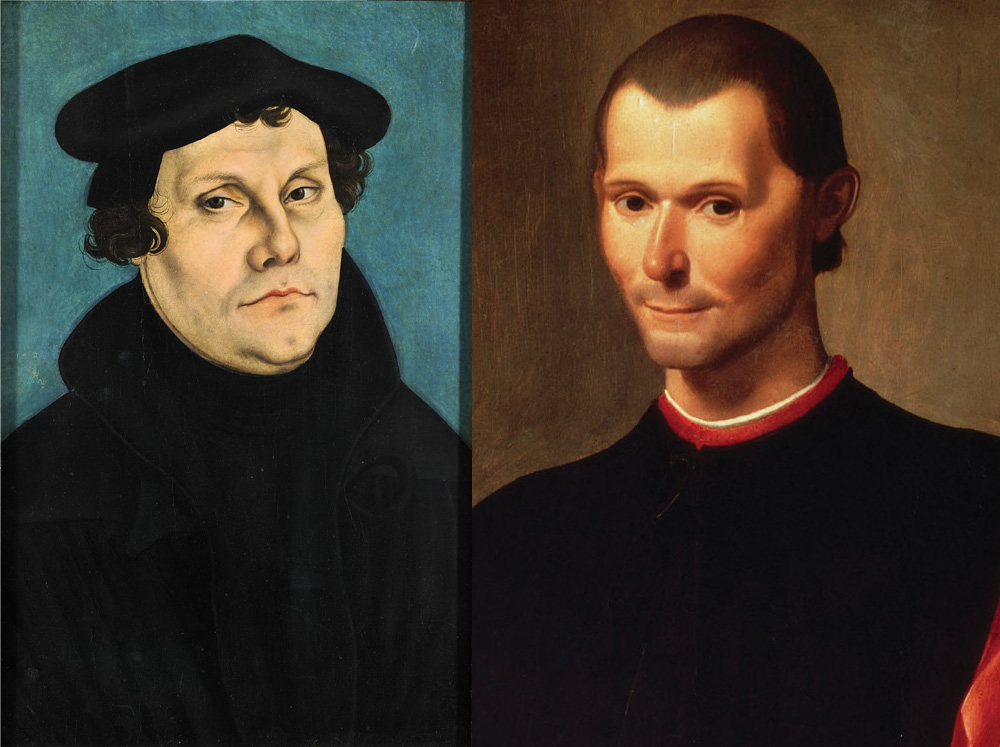
Between 1350 and 1600, the Renaissance laid the intellectual groundwork for modernity by embracing critical thinking, reason, and creativity. The Renaissance directly threatened the power of the Catholic Church as curiosity led people to contemplate a better world with the wonders of science and the democratic and philosophical teachings from ancient Greece, rather than solely the limited doctrines of the Church. It is also no coincidence that humanism, a deep interest in human potential and development aside from Christian values, came to the forefront of many individuals’ minds as they sought to understand the world for what it was rather than on Christian terms. A newfound inquisitorial drive and human agency paired with the ever-growing corruption of the Catholic Church and its leadership contributed heavily to the Protestant Reformation and creation of new sects of Christianity. Martin Luther, a German monk, played a pivotal role in the Protestant Reformation: first in 1517 with his 95 Theses, and later in 1520 with his Address to the Christian Nobility calling for a new temporal governing power rather than the spiritual power of the Church. This theme of secularism—separation of Church and state—was concurrent with Niccolò Machiavelli’s 1513 book The Prince where Machiavelli explores the difficulties of defining what ‘good’ leadership means, and how effective leadership must operate beyond the restrictions of Christian virtues. Martin Luther and others’ challenges to the authority of the Catholic Church during the Protestant Reformation paired with Machiavelli’s dedication to Renaissance era thinking that shaped his controversial vision for new leadership created a long-lasting debate on the extent of secularism and the use of Christian virtues in government.
While the Catholic Church and the papacy may have started out as a righteous institution bent solely upon God’s will, slowly but surely the corrupt papal leadership tainted the reputation and credibility of the Church. The original practice of finding salvation could be achieved by acts of devotion to God and to faith; to be forgiven would require turning away from the original sin and giving back to one’s spiritual community. When the mission of the Crusades was first encouraged by Pope Urban Ⅱ in 1095, the practice of genuine salvation was diminished to plenary indulgences which granted full remission of sins to those who volunteered to partake in the Crusades. Later, Pope Leo Ⅹ (1513-1521) distanced salvation even further from its original meaning by offering indulgences as monetary transactions, which allowed the papacy to greatly enrich the Church. This was directly contradicting the Gospel of Luke which urges, “Take heed, and beware of a covetousness: for a man’s life consisteth not in the abundance of the things which he possesseth” and the counsel given by the apostle Paul to Timothy asserting “For the love of money is the root of all evil: which while some coveted after, they have erred from the faith.”1 As it was each Popes responsibility to interpret and uphold God’s word, they fell under scrutiny by citizens and other members of the Church who believed them to be misusing their power and supposed divine right to manipulate the Church’s practices to benefit themselves.
Martin Luther, concerned by the moral degeneration of the Church, set the Reformation of the Catholic Church into action in 1517 with his 95 Theses which laid out the illegitimate practice of the Church offering indulgences, which could be paid to repent for sins.2 The practice of indulgences was a power claimed by the Pope, which created a middle person in God’s judgement and his divine right to determine the salvation of his followers; this idea was at the heart of Luther’s 95 Theses as he wanted to raise a debate about the Church’s misguided practices.3
Luther may have been the first to become the face of the Reformation as he successfully spread his writing through the power of the printing press in vernacular languages across Germany and beyond, but others, such as John Calvin, also made a significant impact and gained a following in the footsteps of Luther. John Calvin, a French Pastor, wrote The Necessity of Reforming the Catholic Church in the 1540s. The text is divided into three sections focusing on worship and salvation, the sacraments, and church government. Calvin claimed that the legitimate worship and comprehension of the idea of salvation by the papacy had been rendered “obsolete”, that their use of the sacraments and word of God was extremely “polluted”, and finally that the government of the Church had become a “tyranny.” The form of worship that Calvin suggested was one in the vernacular language that people could truly understand instead of “mutter(ing) over confused prayers in an unknown tongue” (i.e. Latin), as well as experiencing a close connection to God directly, rather than having to be attached to a patron of the Church in order to practice. In terms of the sacraments, Calvin explains how the Church patrons—such as the Pope, Bishops, and Priests—do not uphold the expectation of accurately teaching God’s word, and that the sacraments have been “sullied” by the patrons’ self-serving interpretations of the holy texts. The last piece Calvin touches on is the Church’s government; he asserts that the majority of the leading patrons are lazy and not diligently upholding their responsibility to teach and exemplify God’s word. Calvin’s The Necessity of Reforming the Catholic Church is similar in message to Luther’s 95 Theses, but Calvin specifically aims to explain the current standing and circumstances of the old (Catholic) and new (Protestant) Church to the people in clear language, whereas Luther’s 95 Theses were more of a shortened list of the Catholic Church’s grievances addressed to fellow churchmen.4
Within these two influential pieces of writing, Luther and Calvin convey similar messages, ultimately calling for the reform of the Church and the possibility of a better alternative. While Calvin and Luther align in these prior pieces, they seem to differ in Luther’s Address to the Christian Nobility written in 1520. Luther not only restates his prior challenges against the corrupt Catholic Church practices and misconceptions but also poses a new question about the potentiality of temporal (local) leaders over the spiritual leaders of the Church. Luther claimed that the temporal leaders, such as local princes and other authorities not directly tied to the Church, were baptized just as any other priest or bishop, and should therefore have the same opportunity to lead. To support this idea, Luther challenged the authority of mere priests and bishops as they have been given power or appointed by a higher authority, just as any other could be, and consequently that they were simply officeholders. Ultimately, Luther is introducing the idea that different regions should have the option of local religious authority, rather than that of an ever-growing more distant Church bureaucracy.5
The Address to the Christian Nobility may seem to be a writing in favor of the ‘greater good’ for the people, their religious practices, and governance, but it is also important to consider the impact that Luther’s audience and the amount of pressure he was facing from the Catholic church in the 1520s could have had on the intentions of the text. Around the same time that Luther wrote the Address to the Christian Nobility, Hans Schwarz—a Lutheran theologian and scholar—clarified in “Luther’s Life and Work” that Luther had already been pushed by the Catholic Church and many of its patrons to stop the printing and spread of his writings.6 Luther, naturally, did not comply with the Church’s order and was forced into hiding after being excommunicated by the Church for disregarding their order.7 Luther’s audience, as hinted by the title, was the German Christian nobility. Not only was he trying to persuade them to buy into his sentiment towards the need for Reformation, but Luther also offered a shift in governing power to temporal leaders which would positively impact the nobles themselves. Therefore, Luther was in pursuit of personal security in addition to general support for the Reformation.
Martin Luther’s proposition to replace spiritual leaders with temporal ones can be attributed to the corruption he saw in the Church, but also in the way he believed that the temporal powers held proper institutional powers to govern beyond the Church.8 Luther explicitly said that the “work” of spiritual leaders is to teach and uphold God’s word, whereas temporal leaders “bear sword and rod with which to punish the evil and to protect the good,” meaning that their work was to enforce God’s word by sword and punishment—if need be—a power he did not believe could be held by spiritual patrons of the Church.9
Far off from Martin Luther’s sentiment towards the virtue of religion but close to Luther’s idea of the necessity for temporal powers was Niccolò Machiavelli’s The Prince. Nicolo Machiavelli’s political career did not begin when he wrote The Prince in 1513 but instead began in the short-lived Republic in Florence that formed during the Italian Renaissance. Eric Voegelin, a German-American political scientist, explains how Machiavelli got his start in Florence after the Medici family—wealthy bankers who gained political power and eventually rose to govern Florence—were ousted by Charles ⅤⅠⅠⅠ of France who led an invasion on Italy in 1494. After the removal of the Medici family, the Florentine hereditary monarchy was replaced with a republic in which Machiavelli served as a diplomat and secretary of foreign affairs.10 Machiavelli only served in the position until 1512, when France had suffered enough defeats trying to secure control of Italy, and the Medicis again rose to power, leading to Machiavelli being dismissed from his position and exiled to his family home outside of the city where he wrote The Prince.11
In The Prince, Machiavelli engaged in complex debates about what it means to be a good leader, reflecting on the different forms of government and leadership he experienced in Italy. Machiavelli neglects writing of the republic and instead explores principalities: a state that is governed by one sole authority—a “prince.”12 Machiavelli categorized principalities into two separate entities: new and old. Old principalities are those in which the prince is chosen by hereditary or traditional power lines, whereas new principalities have a prince who has been chosen by the people or another authority to rule, whether based on patronage (what he calls good fortune) or merit (experience and knowledge). Machiavelli explained each of these principalities as having different strengths and weaknesses, but he laid out many qualities he believes any prince should learn to balance when governing such as liberality and meanness, clemency and cruelty, and faith and religion.13
Machiavelli asserted his position on the roles religion and church values have in politics in Chapter 18 of The Prince, where he revealed when and how a prince should promote or reject religious values while governing the state. In this chapter, Machiavelli anticipates Luther’s belief that spiritual leaders could not carry out the force needed to protect states like temporal leaders could, and further expanded upon it by adding that Christian virtues do not permit a prince to govern in a way that prolongs the survival of the state and its security—in both land and the prince’s rule.14 Graham Maddox, a professor at New England University who studies political thought and comparative politics, argues that Luther and Machiavelli both “set out to deconstruct the political authority of the Church” while urging a separation of church from the state government, but they diverged in the ways they relied on scripture and literature when developing their political philosophies.15 Maddox explained that Luther derived his philosophy from “pristine Christian writings” and “the unmediated working of the (holy) Spirit,” whereas Machiavelli sought to “bypass Christianity altogether” by using ancient classical and Latin texts to develop a philosophy disconnected from the teachings of God.16 Where Luther merely urged a separation of powers between the Church and the State but temporal leaders who still practiced the doctrines of Christianity, Machiavelli challenged the traditional practice to a greater extent—in a way Luther would likely not have agreed with—by arguing that the prince should not stay within the confines of what Christianity permits, but should rely instead on his own agency and judgement.17 Although Machiavelli does not believe Christian virtues have a place in government or politics, he did argue that sometimes it is advantageous for a prince “to appear merciful, faithful, humane, religious” when it can boost his own reputation and popularity.18
John Calvin and Martin Luther would have supported a form of secularism that separated the church and the state, but not one where Christianity and its virtues were absent from governing leaders. Both men became the backbone of the Protestant Reformation, challenging the unrivaled power of the Catholic Church, but not the worth of the Christian Church as a whole. Machiavelli, on the other hand, did not believe mere secularism to be enough, but instead that Christian virtues had reached the end of their dominant role in the government. Calvin and Luther’s lasting devotion to Christianity and the Church made them key players in the Reformation, but not direct embodiments of Renaissance era thinking which would have relied on science and classical texts from ancient Greece and Rome, like Machiavelli’s philosophy more closely did. This divide in Reformation and Renaissance thinking did not end in the early-mid 1500s at the times they wrote their most influential pieces, but it continued throughout the late 1500s and 1600s as religious wars over Catholicism and Protestantism combined with struggles over control for political and social power engulfed all of developing Europe. The forms of secularism that Calvin and Luther inspired did not instantly become reality, and Machiavelli’s idealized separation from Christian values in government would take even longer to come to fruition than the separation of powers the Reformers sought. These early 1500s thinkers forever challenged the status quo, and later scholars in the Age of Enlightenment (17th and 18th centuries) and the progress towards the American (1775-1783) and French (1789-1794) Revolutions may not have materialized the same without their fundamental contributions.
1. The New Testament (Intellectual Reserve, Inc., 2014), 1299, 1511, https://www.churchofjesuschrist.org/bc/content/shared/content/english/pdf/language-materials/83291_eng.pdf.
2. Martin Luther, 95 Theses (1517), http://reverendluther.org/pdfs/The_Ninety-Five_Theses.pdf.
3. Luther, 95 Theses.
4. John Calvin, “The Necessity of Reforming the Catholic Church,” in Ideas and Identity in Western Thought: Readings in Politics, Economics, Society, Law, and War, ed. Micheal Holm (Cognella, Inc., 2023), 76.-80.
5. Martin Luther, “Address to the Christian Nobility,” in Ideas and Identity in Western Thought: Readings in Politics, Economics, Society, Law, and War, ed. Micheal Holm (Cognella, Inc., 2023), 70.
6. Hans Schwarz, “1: Luther’s Life and Work,” in True Faith in the True God: An Introduction to Luther’s Life and Thought (Augsburg Fortress Press, 2015), 24-25, https://www.jstor.org/stable/j.ctt13wwwc2.5.
7. Schwarz, “1: Luther’s Life and Work,” 25.
8. Luther, “Address to Christian Nobility,” 70.
9. Luther, “Address to Christian Nobility,” 70.
10. Eric Voegelin, “Machiavelli’s Prince: Background and Formation,” The Review of Politics 13, no. 2 (1951): 143, https://www.jstor.org/stable/1404762.
11. Voegelin, “Machiavelli’s Prince: Background and Formation,” 143.
12. Niccolò Machiavelli, The Prince, trans. Rufus Goodwin (Dante University Press, 2003), https://www.google.com/books/edition/The_Prince/bRdLCgAAQBAJ?hl=en&gbpv=1&pg=PA1&printsec=frontcover.
13. Machiavelli, The Prince, 74-86.
14. Machiavelli, The Prince, 83-86.
15. Graham Maddox, “The Secular Reformation and the Influence of Machiavelli,” The Journal of Religion 82, no. 4 (2015): 539-540, https://www.jstor.org/stable/1206519.
16. Maddox, “The Secular Reformation and the Influence of Machiavelli,” 539.
17. Machiavelli, The Prince, 84.
18. Machiavelli, The Prince, 85.