

You’ve undoubtedly heard the stereotype that every Asian person excels at STEM. According to a Pew 2023 survey, roughly 63% of Asian American respondents said they had faced “model minority” stereotypes in their day-to-day interactions.1 The Model Minority Myth (MMM) is a pervasive misconception that has persisted in America since its founding. Every day, people casually reproduce the myth within offline and online discourse. The MMM not only stereotypes Asian Americans, but also creates expectations and pressures for Asian Americans within their communities; treats Asians as a monolithic people; and is a form of anti-Blackness. The model minority myth persists because its rhetoric disguises racism as praise: by selectively celebrating Asian Americans as hardworking, exceptionally smart, and docile, those who spread the myth recast hard work as cultural merit at the expense of Black Americans and other marginalized groups.
The MMM has persisted for centuries. To understand how the myth began, we must first examine the history of Asian ethnic groups in the United States. In the late 1800s, the Central Pacific leadership wanted to build the Transcontinental Railroad using an all-white workforce, but only a few responded and subsequently left to chase the next gold strike.2 The next available workforce finished the railroad: 12,000 to 15,000 Chinese immigrants. Unfortunately, xenophobia became rampant in the United States soon after they finished the railroad, causing Congress to enact the Chinese Exclusion Act in 1882.3 The act barred Chinese immigration and prevented Chinese immigrants from naturalizing. Fast-forward to World War II: China became a U.S. ally, and Congress repealed the Chinese Exclusion Act.
Following Pearl Harbor, the American government recast Chinese Americans as “good” Asians in contrast to “bad” Japanese.4 Americans feared the Japanese; however, they could not differentiate between the two, leading to Americans harassing the Chinese population. A WWII propaganda piece written for LIFE Magazine highlights this fear by explaining how white American readers can “tell” the difference between the two; already, the word “tell” in the title gives the reader a sense of authority in sorting people into “safe” versus “dangerous.” The diagram claims the Chinese have a “parchment yellow complexion,”5 whereas the Japanese have an “earthy yellow complexion.”6 This piece teaches readers to visually sort allies from enemies based on facial features. While these differences may seem empirical, the rhetoric utilizes scientific authority to justify racial categorizations. The author describes a Chinese public servant, Ong Wen-hao, as “delicately boned,” “slenderly built,” and wearing a “rational calm of tolerant realists.”7 These phrases paint Chinese people as civilized and rational.
In contrast, the author describes Japan’s prime minister, General Hideki Tojo, as “massive,” with a “heavy beard,” and showing the “humorless intensity of ruthless mystics.”8 The author’s diction here portrays the Japanese as primitive and threatening, echoing the fears from Pearl Harbor. The author claims Chinese people are European-adjacent, asserting that “Chinese sometimes pass for Europeans.”9 This claim measures the worthiness of the Chinese through proximity to whiteness, with the Chinese superior to the Japanese. The author constructs a racial hierarchy where proximity to whiteness equates to goodness. In the 1940s, the American government touted an all-Japanese unit that suffered heavy casualties fighting against German forces in Europe during WWII as a positive example of patriotism, reshaping the Japanese American image. However, this logic still underpins the model minority myth.
The rhetoric within the MMM includes the misconception that Asian American success is culturally inherent, which implies that other minority groups like Black Americans fail due to cultural deficiencies rather than systemic racism. During the Cold War, politicians such as Richard Nixon and George Wallace chose to popularize Black and brown Americans as “problem minorities” compared to the passive, hardworking Chinese and now Japanese minorities. Howard M. Imazeki, the longtime English-section editor of San Francisco’s Japanese American daily Hokubei Mainichi newspaper, offers a striking example of an Asian American contributing to the MMM. Born in Japan in 1907, Imazeki immigrated to the United States at age eleven and was incarcerated at Tule Lake during WWII.10 Yet in 1963, he argued that the Black community needed to better itself and its environment to secure equal rights. Imazeki divides inter-community solidarity, arguing that “The Negroes have led their lives of their own. […] in the South especially were people far detached from our lives.”11 Imazeki perpetuates a “racial wedge” against other communities and asserts proximity to whiteness by declaring that Black Americans are separate from the Japanese communities. The separation between “our lives” and “their lives” reflects Imazeki’s belief: there are two different groups with completely different lives. This idea prevails through phrases like “lives of their own” and “far detached,” creating distance between the two groups. The choice to emphasize “The Negroes in the South especially” rather than all people living in the South demonstrates Imazeki’s emphasis on racial separation. He continues, “They blame society for their woman-folks giving birth to illegitimate children and living on welfare checks.”12 Imazeki creates specifically harmful rhetoric about Black women through his diction. By referring to Black women as “woman-folks,” Imazeki contributes to the intersectional invisibility: the separation of Black women from Black men and white women.
Additionally, Imazeki’s generalization that Black women have illegitimate children and rely on welfare checks implies that Japanese women do not behave similarly. Not only does this rhetoric contribute to the wedge between Black and Japanese communities, but it also contributes to society’s stereotype of the Japanese (and later other Asian groups) as hard-working people, a culturally inherent result, who, according to society, do not need “handouts” from the government to succeed. Imazeki emphasizes this point: “they blame all of their anti-social habits and cultural maladjustment on the ‘unjust’ community in which they live.”13 Imazeki not only denigrates Black Americans but also argues their inability to integrate into American society stems from their own lack of discipline and work ethic, unlike the Japanese.
Black activists led the struggle for the Civil Rights Act of 1964, which benefited Asian Americans.14 Simultaneously, the media and politicians doubled down on the model minority narrative and the assertion that Asian Americans are the ideal minority. Two landmark articles in 1966 cemented this.
Sociologist William Petersen affirmed this narrative in “Success Story: Japanese-American Style.” Petersen’s use of “success story” in the title frames the Japanese as a model group, priming readers to interpret the article as the triumph of the Japanese over their historic struggles in America. He claims Japanese Americans are “better than any other group” because they succeeded with “almost totally unaided effort” and produced a success story with “ no parallel.”15 His rhetoric echoes Imazeki’s idea that the Japanese do not rely on welfare, inherently putting other groups down through his praise. He deepens that praise by describing them as “exceptionally law-abiding,” associating them with “achievement orientation.”16 Petersen’s diction connotes that other groups are prone to breaking the law, unlike the respectable Japanese. The phrase “achievement orientation” serves a similar purpose: Japanese Americans excel academically and professionally, achieving success beyond what other minorities have achieved. His rhetoric continues when he paints Japanese Americans as the hardest workers, followed by the Chinese, demonstrating roots for the MMM. Petersen emphasizes their “greater attachment to family” and “greater respect for parental and other authority.”17 Petersen’s rhetoric frames Asian Americans as the “best minority” because he praises them as the epitome of many American societal values, like being family-oriented and hard-working. Petersen’s descriptive rhetoric contributes to another side of the MMM: Asian Americans are studious and good at schoolwork. He calls Japanese American students “squares” who dress with “unostentatious neatness,”18 language that frames Japanese Americans as modest and disciplined. This rhetoric does more than compliment Japanese Americans; it constructs them as a model minority whose value lies in hard work, obedience, and closeness to dominant American norms. Petersen uses that idealized image to imply that other minority groups fail because they lack those same traits rather than because they face systemic racism.
Chinese Americans faced similar praise from American society, laying the groundwork for the MMM. In 1966, an uncredited author praised Chinese Americans: A Protestant pastor explains, “we’re a big family […] nobody will respect any member of the family who does not work and who just plays around.”19 The author uses a community leader’s authority to frame the Chinese American community as obedient, attributing this to their familial upbringing. Rhetoric describing Chinese culture and familial expectations as “expected to attend school faithfully, [work] hard at their studies—and stay out of trouble,” frames Chinese American children as academically focused and well disciplined.20 The diction and attitude present these behaviors as normal for children, as if built into Chinese culture: Asian students are naturally studious and obedient. The author’s repetition of “strict discipline” emphasizes control and obedience, constructing the stereotype that Asian success comes from rigid family discipline.21 A high-praise attitude underscores this rhetoric: “if school performance is poor […] there is an immediate improvement” and “schoolteachers reportedly are competing for posts in schools with large numbers of Chinese-American children.”22 These comments emphasize the belief that Asian students are naturally good students because of their families and culture; however, they socially validate and reward the stereotype about Chinese-American children. Teachers view Chinese students as desirable because they seem easier to teach. This emphasis on Asian success resulting only from inherent cultural differences overshadows Asian achievement by reframing it as a cultural inevitability.
Redditor Mindless_Engineer asks, “why Asians are stereotyped as good at math and science?”23 Redditor TheDratman answers, “Culture. Their culture promotes rapid learning and more work, which leads to more developed knowledge of math and science. If we studied and worked the way they do, we’d be the same.”24 This answer reflects how Asian American successes are not only diminished as the norm culturally, but also how Asians are exemplary because their achievements are a result of their cultural discipline. Furthermore, TheDratman’s closing line implies that success is simply a formula, which erases the structural barriers other groups face.
Redditor JcDonovan154 says, “Asians are the best race: They’re super open-minded and respectful.”25 Commenters like JcDonovan154 might ask how this type of comment could be harmful despite its complimentary tone. Shouldn’t people be happy to be praised? While these positive stereotypes may seem flattering, they perpetuate the idea that Asian Americans are a monolithic group that holds the same behavioral characteristics regardless of ethnic origin, culture, or background. In this view, East Asians, Southeast Asians, and South Asians share the same qualities: intelligence, docility, and hard work. These “positive” stereotypes also offered no real protection for Asian Americans from anti-Asian violence related to the COVID-19 pandemic. Between March 2020 and December 2021, Stop AAPI Hate received 10,905 reports of hate incidents against Asian Americans and Pacific Islanders. Race was cited as a reason in over 90% of these reports.26 People engaged in hate speech and crimes against Asian Americans regardless of their individual ethnic origin.
Some agree with the MMM but do not see Asians as a monolithic people. Responding to JcDonovan154’s post, another Reddit user, confused_ml, asked, “we’re talking about far east asians and not south asians, right?”27 While this perspective may not align with the monolithic people generalization, it exemplifies how the MMM harms those within the Asian community who are not East Asian. This perspective subjects non-East Asian individuals to the same treatment that “problem minorities” face from the racial hierarchy belief.
It’s hard to remain unaffected by societal norms or beliefs like the MMM. While some feel that these stereotypes are positive and important to demonstrate minority success in America, the MMM both harms Asian Americans and other minorities. Before believing and perpetuating these stereotypes, it’s important to recognize their larger impacts: a 2025 study found that “Asian American students reported significantly higher exposure to academic stereotypes than international peers. Academic stereotypes were associated with poorer mental health among Asian American students.”28 Smaller comments about “how math should be easy for an Asian” contribute to the pressures that Asian American students feel.29 By flattening Asian success into a cultural given, the myth leaves Asian Americans feeling that their achievements are never enough. The affirmative action debates exemplify how conservative groups continuously target Asian Americans who weaponize this myth and its rhetoric.
Densho. “Inventing the ‘Model Minority’: A Critical Timeline and Reading List.” Densho, December 15, 2021. https://densho.org/catalyst/inventing-the-model-minority-a-critical-timeline-and-reading-list/.
“How to Tell Japs from the Chinese.” Life, December 22, 1941, 81. https://www.reddit.com/r/HistoryPorn/comments/11euj8i/life_magazine_how_to_tell_japs_from_the_chinese/
Hua, Vanessa. “Golden Spike Redux.” National Parks, Summer 2019. https://www.npca.org/articles/2192-golden-spike-redux.
Imazeki, Howard M. “Editorial Grist: A Nisei Speaks To Negroes.” Colbert Country Reporter, August 22, 1963. https://civilrightsshoals.com/object/editorial-grist-a-nisei-speaks-to-negroes/.
JcDonovan154. “Asians are the best race.” Reddit, 2019. https://www.reddit.com/r/unpopularopinion/comments/apdwk2/asians_are_the_best_race/.
Li, Changyue, Linda Serra Hagedorn, and Hang Cui. “The Model Minority Myth and Asian Students’ Mental Health: A Comparative Analysis of Asian American and International Students and the Moderating Role of Citizenship Status.” Cultural Diversity & Ethnic Minority Psychology, July 28, 2025. https://doi.org/10.1037/cdp0000764.
Mindless_Engineer. “ELI5: Why are Asians good at math and science? Or are they not?” Reddit, 2015. https://www.reddit.com/r/explainlikeimfive/comments/2tdw9z/eli5_why_are_asians_good_at_math_and_science_or/.
Niiya, Brian. “Howard Imazeki.” Densho Encyclopedia. Accessed 9/21/2026. https://encyclopedia.densho.org/Howard_Imazeki.
Petersen, William. “Success Story, Japanese-American Style.” New York Times Magazine, January 9, 1966. https://www.nytimes.com/1966/01/09/archives/success-story-japaneseamerican-style-success-story-japaneseamerican.html.
Ruiz, Neil G., Carolyne Im, and Ziyao Tian. “Discrimination Experiences Shape Most Asian Americans’ Lives.” Pew Research Center, November 30, 2023. https://www.pewresearch.org/race-ethnicity/2023/11/30/discrimination-experiences-shape-most-asian-americans-lives/.
“Success Story of One Minority Group in U.S.” U.S. News and World Report, December 26, 1966. https://teaach.education.illinois.edu/docs/teaachcollegeofeducationlibraries/default-document-library/george-takei.pdf?sfvrsn=f385a5e2_1.
Stop AAPI Hate. National Report. March 2022. https://stopaapihate.org/national-report/.
1. Neil G. Ruiz, Carolyne Im, Ziyao Tian, “Discrimination Experiences Shape Most Asian Americans’ Lives,” Pew Research Center, November 30, 2023, https://www.pewresearch.org/race-ethnicity/2023/11/30/discrimination-experiences-shape-most-asian-americans-lives/.
2. Densho, “Inventing the ‘Model Minority’: A Critical Timeline and Reading List,” Densho, December 15, 2021. https://densho.org/catalyst/inventing-the-model-minority-a-critical-timeline-and-reading-list/.
3. Vanessa Hua, “Golden Spike Redux,” National Parks, Summer 2019, https://www.npca.org/articles/2192-golden-spike-redux.
4. Densho, “Inventing the ‘Model Minority’: A Critical Timeline and Reading List.”
5. “How to Tell Japs from the Chinese,” LIFE, December 22, 1941, 81.
6. “How to Tell Japs from the Chinese,” 81.
7. “How to Tell Japs from the Chinese,” 81.
8. “How to Tell Japs from the Chinese,” 81.
9. “How to Tell Japs from the Chinese,” 81.
10. Densho Encyclopedia, s.v. “Howard Imazeki,” https://encyclopedia.densho.org/Howard_Imazeki.
11. Howard M. Imazeki, “Editorial Grist: A Nisei Speaks To,, Negroes,” Colbert Country Reporter, August 22, 1963.
12. Imazeki, “Editorial Grist: A Nisei Speaks To Negroes.”
13. Imazeki, “Editorial Grist: A Nisei Speaks To Negroes.”
14. Densho, “Inventing the ‘Model Minority’: A Critical Timeline and Reading List.”
15. William Petersen,“Success Story, Japanese-American Style,” The New York Times, January 9, 1966, 2-3.
16. Petersen,“Success Story, Japanese-American Style,” 11-12.
17. Petersen,“Success Story, Japanese-American Style,” 13.
18. Petersen,“Success Story, Japanese-American Style,” 8-10.
19. “Success Story of One Minority Group in U.S.,” U.S. News and World Report, December 26, 1966, 6.
20. “Success Story of One Minority Group in U.S.,” 6.
21. “Success Story of One Minority Group in U.S.,” 6.
22. “Success Story of One Minority Group in U.S.,” 6.
23. Mindless_Engineer, “ELI5: Why are Asians good at math and science? Or are they not?,” Reddit, 2015, https://www.reddit.com/r/explainlikeimfive/comments/2tdw9z/eli5_why_are_asians_good_at_math_and_science_or/.
24. TheDratman, comment on Mindless_Engineer, “ELI5: Why are Asians good at math and science? Or are they not?”
25. JcDonovan154, “Asians are the best race,” Reddit, 2019, https://www.reddit.com/r/unpopularopinion/comments/apdwk2/asians_are_the_best_race/.
26. Stop AAPI Hate, “National Report,” March 2022, https://stopaapihate.org/national-report/.
27. confused_ml, comment on JcDonovan154, “Asians are the best race,” Reddit, 2019, https://www.reddit.com/r/unpopularopinion/comments/apdwk2/asians_are_the_best_race/.
28. Changyue Li, Linda Serra Hagedorn, and Hang Cui, “The Model Minority Myth and Asian Students’ Mental Health: A Comparative Analysis of Asian American and international Stuents and the Moderating Role of Citizenship Status,” Cultural Diversity & Ethnic Minority Psychology, Jul 28, 2025, https://doi.org/10.1037/cdp0000764.
29. Li, Hagedorn, and Cui, “Model Minority Myth and Asian Students’ Mental Health.”
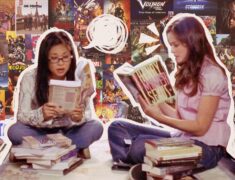
May 2007 made literary history, albeit in two different realms: the established and the subversive. The former announced the first London Literature Festival, beginning an annual celebration that pedestals brilliant authors and spotlights publishing accomplishments. The latter founded the Organization for Transformative Works, a nonprofit to preserve and protect “fanworks”—to uplift the hobby creations of thousands of writers, artists, and fans. Yet today, this seemingly stark divide between “formal” and “informal” literature continues to close as the literary world reckons with the actual, potential value of fandom. Fandom is broadly defined as a fan collective of a book, movie, game, or other piece of media that, in turn, creates inspired fanworks such as fanart, fanfiction, blog posts, and podcasts. These creations are commonly known as transformative works, as they “transform” a source material into a uniquely interpreted product. I spent most of my childhood being an individual fan: in elementary school, I obsessed over the Harry Potter books, the My Little Pony TV series, and even Louis Sachar’s famous novel, Holes. But my true introduction to the fandom unit was in my fifth grade class. My English teacher had created a plethora of lunchtime book clubs for our classroom, with each focusing on a popular series: The Hunger Games, Percy Jackson, Warriors, and many more. During lunch, I would pop open my soup thermos and chat with fellow classmates in the Harry Potter book club—discussing the shocking plot twists, geeking out over favorite scenes, and debating which character was the best. At the age of ten, my passions had brought me into a community, one that encouraged my critical thinking and social engagement. Moreover, the experience introduced to me the idea of fandom in the classroom—fandom as an educational method.
As a long-time participant in fandoms, I want to explore this overlooked, stigmatized, and almost taboo aspect of pop culture and align it with the contrastingly well-respected field of education. With the growing popularity of fan culture, the decline in youth literacy, and the evolving climate of education in a post-COVID, technology-driven society, fandom-based pedagogy is worth implementing into the classroom as a tool to teach students various skills—such as reading comprehension, writing, and collaboration—in an engaging and contemporary way.
Despite its educational potential, many people dismiss the possibility of fandom and fanfiction’s academic merit because of public opinion’s preconceived notions; often, mainstream media characterizes fandom participation as obsessive, gauche, and juvenile. For one, Daryna Stanko and Iryna Kolegaeva observe that many critics believe the “informal nature” and “amateur writing” of fanfiction “may reinforce poor grammar or stylistic habits,” prevent students from preparing for “more structured, formal writing tasks,” and limit students’ ability to exert original thought by creating reliance on a source material with pre-existing characters and storylines (207, 211). With consideration to these concerns, Stanko and Kolegaeva specifically recognize fanfiction’s academic merit only in the specialized instances where it exhibits sophisticated language use, “linguistic complexity,” and “thematic richness” (208). Although their stance contains more nuance than most, it still supports the generalized notion of quality fanwork as exceptional and fandom frivolity as otherwise universal.
In an age of declining literacy, however, upholding this elitist separation—both between traditionally published writing and fanfiction as well as between “good” and “bad” fanfiction—further discourages students from pursuing reading and writing habits. In his review of Karis Jones and Scott Storm’s Fandoms in the classroom—a proposal to use comics, websites, and online posting forums in curriculums—Scott Gregory asserts that although fanfiction and other traditionally non-academic writing is often dismissed as “lowbrow” and “inferior,” “‘text is text’ no matter what format words appear in” (369). Jaime R. Roots similarly criticizes this “hierarchical division between what students perceive as ‘high’ and ‘low’ artforms,” stating that it limits the scope of academic critique and exploration (10). Ultimately, treating all text as being worthy of examination and analysis, as Peter Gutiérrez argues, allows students to develop media comprehension, respond to texts critically, and apply those skills universally, not just to scholarly works that fit the classical criteria for literary tradition (228). Although some of these quality limitations can apply to fanfiction use in formal educational settings like the classroom, I argue against upholding those limitations in daily life. If we are to push back against the illiteracy, conformity, and indifference that currently threatens our society, we must be willing to read and write beyond the construct of what is “worth” consuming. Regarding critics’ concerns about the creative restriction of writing within the bounds of pre-existing intellectual property, adaptation has always been an avenue for creativity, not a hindrance, even within classic and well-lauded media. John Milton’s Paradise Lost reimagines the Bible with subversive nuance and sympathy towards sinful behavior; Leonard Bernstein’s West Side Story alters Shakespeare’s Romeo and Juliet into a class-conscious musical; Jean Rhys’s Wide Sargasso Sea transforms Brontë’s Jane Eyre into a post-colonial critique. Thus, to dismiss fanworks as lazy and unsophisticated is to turn down endless opportunities for art education, exploration, and creation.
Foremost, fan culture relies on participation, socialization, and collaboration, practices that can bolster students’ learning experiences and interactions with source materials. Gutiérrez explains that “an integral part of being a fan is finding out what the other fans think” (230). Particularly with book fandoms, he emphasizes that “the act of reading itself is not complete until one’s thoughts and questions can be aired, replied to, filtered, and probed by another fan” (230). Fans, Gutiérrez says, “engage in ongoing, meaningful, and authentic discourse” with fellow enthusiasts through beta reading (test reading) each other’s fanfiction before publication, interacting with each other’s online posts, and asking each other about “[w]hat was confusing…inconsistent…[or] being foreshadowed” in the media (230). Thus, classrooms can mirror this inherent social component of fandom to promote student engagement and collaboration. To explore this potential, Jaime W. Roots, a professor at Washington and Lee University, experimentally incorporated fanfiction into his “Fairytales Through Pop Culture” course: he tasked students to write fanfiction as a creative-writing project, with the source material being a chosen fairytale. As part of the assignment, “each student also served as a beta reader for three different students, providing feedback on drafts of their projects” (Roots 6). Roots states that in implementing peer review, students find value in their fellow students’ opinions and learn beyond teacher or professor instruction (12). Ultimately, “Learning is a social activity,” Roots asserts (6). In “Fandom: The classroom of the future,” Paul Booth too promotes this philosophy—one that is intrinsic to fandom culture—as a classroom strategy and claims that fans who can debate ideas civilly, offer compliments and criticisms respectfully, and collaborate with fellow fans are, in turn, students who can utilize those same social skills with their peers (9).
This idea of fandom social engagement connects to the greater concept of how interacting with and creating fanworks can teach students critical thinking and media analysis skills. In particular, through its exploration of—and deviation from—source material, fanfiction creates an opportunity for social commentary and deeper investigation of literary devices. Passionate fans have an intrinsic motivation to probe the media they love. Booth reveals the rigor of these investigations, as they range from “Bechdellian analyses of the roles of women in media” and “gender representation in comic books” to “Joseph Campbell’s classic hero’s narrative in young adult fiction” and “video game narrative dissonance” (2). Naturally, fans approach social issues along the way that they can further examine in their fanworks. For example, Gregory reviews Jones and Storm’s classroom exercise, where they instructed students to select fandoms and were encouraged to dissect potential attitudes of misogyny and homogenous identity present in them; in the end, students were able to identify not just sexism, but racism, homophobia, classism, and ableism in media that people otherwise might not look into deeply, such as Gossip Girl and Disney movies (370). Through implementing fanfiction into his college course, Roots emphasizes the importance of critiquing pop culture in order to recognize stereotypical representations of marginalized groups and to address it in derivative works (9). One can use fandom practices as an avenue for exploring social attitudes through conversing about such issues with other people on fan forums, reinterpreting the canon (the authority of the original work) by writing fanfiction with better representations, and implementing greater diversity in fanart by reimagining characters with personal interpretations of identities. Although these educational tactics can be used within classroom settings—as Jones, Storm, and Roots did—its educational quality carries over in its original, recreational form as well. A research project by the Social Science Research Council found that on average, students spend approximately 16% of their time working on and thinking about in-class critical inquiries; in contrast, they spend 51% of their time in leisure (qtd by Booth 7). Therefore, by encouraging fandom activity, Booth argues, students can increase their overall critical thinking by combining the active engagement of class and the passive growth that happens in leisurely fandom participation (7).
Furthermore, fandom pushes students to be creative and develop their writing skills. After all, fanworks are, according to Stanko and Kolegaeva, a “transformative form of expression” (208). On the motivations for creating fanfiction, Henry Jenkins states that derivative works are “born of a balance between fascination and frustration: If media content didn’t fascinate us, there would be no desire to engage with it; but if it didn’t frustrate us on some level, there would be no drive to rewrite or remake it” (qtd in Roots 7). Writing fanfiction is an exercise in turning creative potential into reality. One must brainstorm alternative realities and scenarios for characters, conceptualize what-ifs in the canon’s storylines, and question what aspects of the source material are unsatisfied in order to satisfy them oneself. Gutiérrez highlights “this idea of ‘building upon,’ through commentary, annotation, and remixing” as the premise to fandom’s creative processes, creative processes that ultimately center around adaptation (228). Learning how to adapt existing material can then teach students how to wield a unique kind of artistic freedom, as well as develop traditional writing skills. In “Engaging fan cultures: What students learn when they study fans,” Professors Adam Golub and Ashley Loub refer to fellow instructors who have students compose fanfiction as a way to expand their literary capabilities and, simply, learn creative writing (24). In these classroom exercises, they practice character, plot, and theme development in their derivative works, which can then become a stepping-stone for future original creations. Students come to think of source material not as bounds for their imagination, but as a different kind of vehicle for creative ideas.
Ultimately, what makes didactic fandom—fandom that has the ability to teach—such a unique opportunity for the classroom is how it can encourage students to read and write by catering to their interests and allowing them to participate in these activities with enjoyment and intrinsic motivation rather than apathy. In the United States, United Kingdom, and other nations, reading rates have been on a dire decline in the last 20 years. According to the National Literacy Trust, the enjoyment level of reading in UK youth has dropped 36% percent since 2005; only 1 in 5 students ages 8-18 read daily in their leisure time (Clark et al. 2). With this growing disinterest in reading, engagement with fandom practices like blogging and fanfiction creates casual opportunities for students to incorporate reading and writing into their everyday lives. Stanko and Kolegaeva affirm that “[s]ince fanfiction is based on popular media, students are often more motivated to read and write about topics they are passionate about, making learning more enjoyable and less of a chore” (212). In a time where students are losing motivation to read and write, discriminating against the content that they engage themselves with further alienates them from pursuing those skills at all. Additionally, motivation and interest in the material improves the educational outcome, as Gregory argues that “student passion becomes a catalyst for greater authentic engagement” (370). Similarly, Chin Ee Loh, a researcher on adolescent literacy, affirms that pleasure fuels self-motivated reading, which leads to increased reading and correlated enhanced reading proficiency (599). Because of this, Loh argues, students should be trusted with autonomy over their media consumption and their ability to find deeper meaning within it rather than have adults and instructors police them (599). If reading and writing about one’s favorite book, comic, or movie motivates one to engage in literary practices, then those personal stakes should be encouraged and can even act as a bridge towards classical literature, original creative writing, and academic papers.
One of the greatest arguments for fandom pedagogy is that it is a relevant, and possibly natural, evolution of learning strategy in today’s ever-evolving educational climate. Currently, educators face the enduring crisis of adapting to a post-COVID and technology-reliant world. In 2025, the National Assessment Governing Board, which administers the Nation’s Report Card—an evaluation of academic performance in the United States—reported that even nearly half a decade after the COVID-19 pandemic, secondary school students continue to score below pre-pandemic performance levels in reading, as well as have declining scores in comparison to 2022 (1). These repeating results illustrate not only students’ persisting academic struggles in today’s climate, but also the failure of current standardized testing and curriculum standards in alleviating them. In tandem, Loh notes that surveys and tests on youth literacy only focus on students’ interactions with traditional books when in reality, the shifting technological and cultural landscape has led youth reading practices to change with them: for example, increased internet access has contributed to adolescents’ growing involvement in digital media, fanfiction, and fandom spaces (599). As Storm and Jones emphasize, “Reading has changed. The way we think about teaching reading needs to change too” (qtd in Gregory 369). By incorporating fandom practices into the classroom, educators adapt to students’ evolving reading habits and cater to their interests and circumstances rather than follow traditional testing and curriculum norms that may no longer benefit students in the modern era. Through this, adolescents are able to have more meaningful experiences with books and reading. Classes can still teach traditional texts, as Booth does in his “Fairytales Through Pop Culture” course, but the contemporary methods they approach the texts with have the potential to accommodate youth reading habits and motivate students towards the literary and comprehension goals that educational institutions ultimately want them to achieve.
To non-fans, though, the idea of fandom in the classroom perhaps appears odd until one realizes that at its core, fan activities are simply, as Golub and Loub call it, “audience participation” (26). Fandom is an amalgamation of people’s reactions to popular culture: the products of fandom, from blog discussions to fanfiction, are the products of the questions, curiosities, love, hatred, or creative urges that emerge from a piece of media. This interactive philosophy to both creation and consumption in fandom makes it such an intriguing opportunity for education. Although the skills of collaboration, critical thinking, and creativity are not practices unique to fandom, the basis of authentic passion and innate motivation within fan culture sets apart this pedagogy as an unconventional approach to learning these universal skills. This growing conversation on fandom’s place in educational spaces is one that scholars, professors, and students are exponentially exploring, from increased research studies to experimental curriculum plans; the concept of a fandom education is not as unfathomable as one might initially assume. Soon, we can move beyond hypotheticals and experiments and towards developing feasible, concrete classroom implementations. People often laud young students, from those in elementary school to college, as visionaries for radical change. Perhaps one of those radical changes is in recontextualizing our literary world by breaking down the elitist barrier between “proper” and “improper” reading, alongside the subjective line between what is deemed truly educational or not. In embracing fandom culture and transforming our education methods, we have the opportunity to transform the way we think and the way we create—but more importantly, to transform ourselves into open-minded, innovative individuals.
Booth, Paul J. “Fandom: The classroom of the future.” Transformative Works and Cultures, vol. 19, 15 June 2015, https://doi.org/10.3983/twc.2015.0650.
Clark, Christina, Irene Piction, and Aimee Cole. “Children and young people’s reading in 2025.” National Literacy Trust, June 2025, https://files.eric.ed.gov/fulltext/ED675290.pdf.
Golub, Adam and Ashley Loub. “Engaging fan cultures: What students learn when they study fans.” Participations: Journal of Audience & Reception Studies, vol. 16, no. 2, Nov. 2019, https://www.participations.org/16-02-03-golub.pdf.
Gregory, Scott. “Review of: Fandoms in the classroom: A social justice approach to transforming literacy learning.” Curriculum and Teaching Dialogue, vol. 27, no. 2, 15 Dec. 2025, https://doi.org/10.22488/okstate.25.100634.
Gutiérrez, Peter. “Focus on policy: The right to be a fan.” Language Arts, vol. 88, no. 3, 1 Jan. 2011, pp. 226–231, https://doi.org/10.58680/la201113416.
Loh, Chin Ee. “What makes adolescents want to read? examining adolescents’ contemporary print and New Media (fiction) leisure reading through Mobile ethnography.” Language and Education, vol. 38, no. 4, 15 Mar. 2024, pp. 596–616, https://doi.org/10.1080/09500782.2024.2326099.
Roots, Jaime W. “Teaching with fandom: Promoting student subject engagement and critical reflection through fan fiction writing.” Transformative Works and Cultures, vol. 46, 14 Sept. 2025, https://doi.org/10.3983/twc.2025.2741.
Stanko, Daryna and Iryna Kolegaeva. “The educational potential of fanfiction: analysis of a derivative text.” Revista Amazonia Investiga, vol. 13, no. 80, 30 Aug. 2024, pp. 204-214, https://doi.org/10.34069/AI/2024.80.08.17.
“The Nation’s Report Card Shows Declines in Reading, Some Progress in 4th Grade Math.” The National Assessment Governing Board, 29 Jan. 2025, https://www.nagb.gov/news-and-events/news-releases/2025/nations-report-card-decline-in-reading-progress-in-math.html.